

This integration is for Elastic Cloud only. It is not compatible with self-hosted Elastic (Elastic Cloud Enterprise).
Connect Your Elastic Cloud Account
Prerequisites
- You must have a Vantage Organization Owner or Integration Owner role to add or remove this integration. See the Role-Based Access Control documentation for details.
- An Elastic Cloud account with access to create API keys with billing permissions.
- Create a free Vantage account, then follow the steps below to integrate Elastic Cloud costs.
Vantage cannot perform writes to your Elastic Cloud organization. Vantage uses the Billing Admin role to read cost and usage data only; it cannot manage organization or deployment settings.
If your organization restricts access to the provider by IP address, add the following Vantage IP addresses to your provider’s allowlist:
54.87.66.453.95.43.13354.162.3.7244.199.143.633.218.103.23
Create the Connection
1
Log in to the Elastic Cloud console.
2
Click your user avatar on the top right. Select Organization.
3
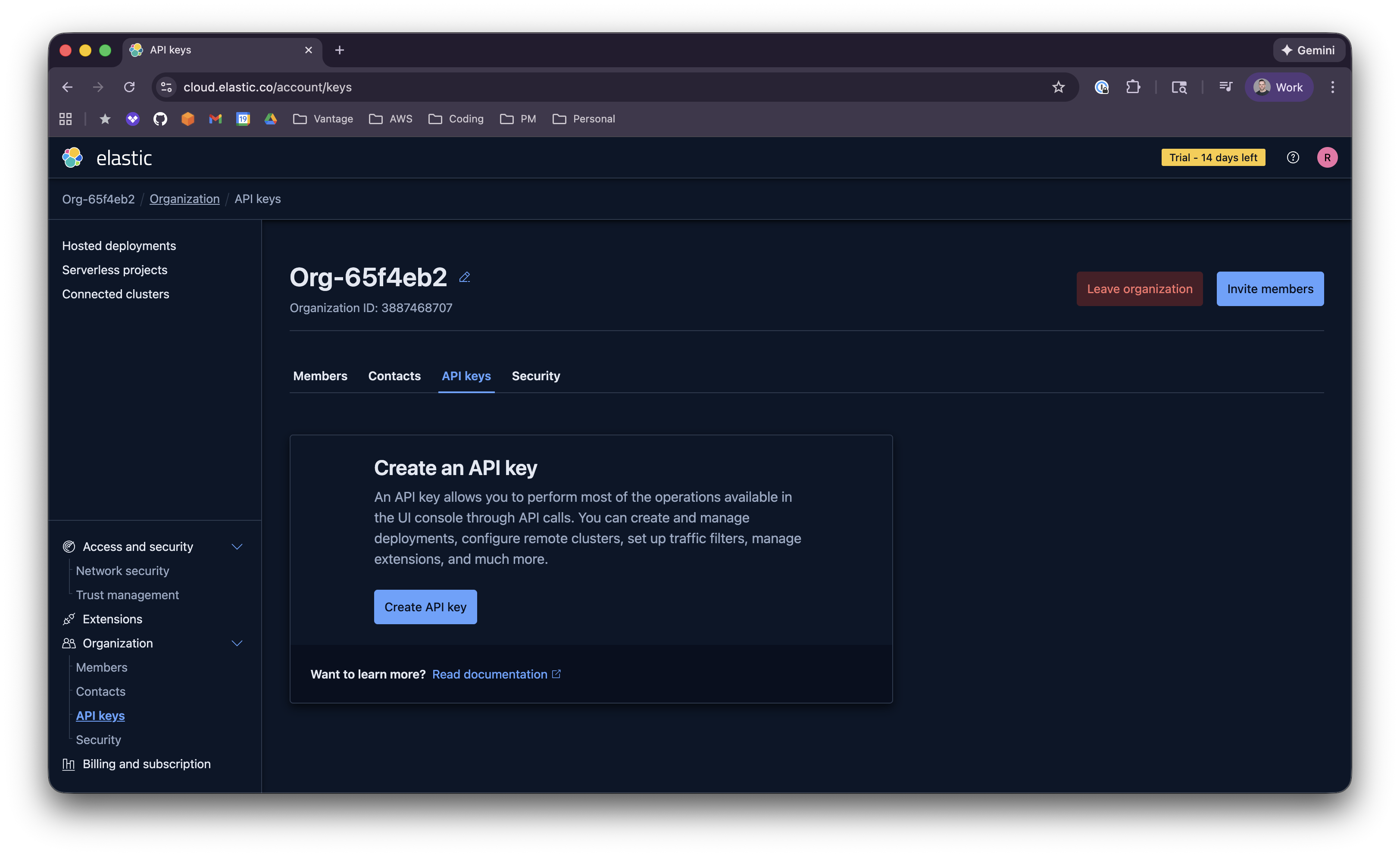
Select the API Keys tab.
Click to view example image
Click to view example image
4
Create a new API key:
- Enter a name.
- Set the expiration (max one year). If the key expires, you’ll need to update the integration in Vantage with a new API key.
- For Assign roles, select the Billing Admin permissions.
5
Click Create API key and copy the API key.
6
In Vantage, from the top navigation click Settings.
7
On the left navigation, select Integrations and select Elastic. Ensure you are on the Connect tab.
8
On the Elastic integrations page, click Add API Key.
9
Enter a Description (e.g., a name for this connection) and paste the API key. Click Connect Account.
If you are an AWS GovCloud user, check the Uses AWS GovCloud box and select your region from the dropdown. This ensures Vantage uses the relevant APIs for GovCloud.
When the integration is first connected, Vantage ingests up to six months of historical Elastic cost data. Data is retained according to your Vantage retention period. If you remove the Elastic integration from Vantage, all associated costs will be removed from the Vantage console.
Next Steps - Manage Workspace Access
Once the integration status is Stable, you can choose which workspaces can use this integration. See Workspaces for how to manage workspace provider integrations.Data Refresh
See the provider data refresh documentation for when Elastic data refreshes in Vantage.Elastic Reporting Dimensions
On Cost Reports, you can filter and group Elastic costs by:- Organization (Account/Billing Account) – Elastic organization ID (each organization accessible by the API key is synced as an account)
- Service – Normalized service name (e.g., Elastic Cloud, Elasticsearch, Kibana, Data Transfer, Storage, Synthetics, APM, Machine Learning; serverless products may appear with a “Serverless” suffix)
- Category – Cost type from Elastic (e.g., capacity, data_in, data_out, storage_bytes)
- Subcategory – Product kind from Elastic (e.g., elasticsearch, kibana, apm)
- Region – Derived from the line item SKU when available (e.g., aws-us-east-2, azure-eastus)
- Resource – When daily cost breakdown is available, deployment or resource name may appear
- Charge Type – e.g., Usage
- Tag – Deployment tags from Elastic Cloud Hosted deployments, plus Virtual Tags created in Vantage for this provider
Vantage applies the tags stored on each Elastic Cloud Hosted deployment to that deployment’s costs. Elastic began returning these deployment tags around August 17, 2026. Costs before that date are often untagged, even when the deployment itself was tagged earlier. Recent months have much higher tag coverage.