- Baseline Forecast: A time-series forecast based purely on historical cost trends, accounting for seasonality and one-off spikes. This is the default forecast type for all Cost Reports.
- Dynamic Forecast: A forecast that you create by uploading projected values of business metrics (such as subscribers, API requests, or transactions) that influence your underlying costs. This forecast type analyzes historical correlations between costs and business metrics to create more accurate projections that align with your business growth expectations.
- Scenario Model Forecast: A forecast that you build by combining the Baseline Forecast with one or more Scenario Models that represent known future costs, credits, or trends (such as committed-use discounts, planned credits, or large one-time charges). Use Scenario Model forecasts to model different scenarios, like conservative and aggressive growth plans, on the same Cost Report.
Dynamic Forecasts and Scenario Model Forecasts are both custom forecasts. A custom forecast can use a business metric, one or more Scenario Models, or both. When you select both, Vantage uses the Dynamic Forecast as the base and applies the Scenario Model adjustments on top.
Dynamic forecasting and Scenario Model forecasting are available to Enterprise customers only. Baseline forecasting is available to all Vantage customers.
Baseline Forecast
To view a baseline forecast on a Cost Report, create a new Cost Report and save it. After you create a new Cost Report, a message is displayed that indicates the forecast is generating. The processing time depends on the amount of data contained in the filtered report, but it usually takes less than 10 minutes.If you add additional filters to an existing report, you need to save the report again for the new forecast to generate. Forecasts are generated based on saved data.
1
On the left, under Forecast Periods, select either Next Month, Next 3 Months, or Next 6 Months.
2
Click Apply. Change to either the bar or line chart view to see a forecast.
- Bar Chart View
- Line Chart View
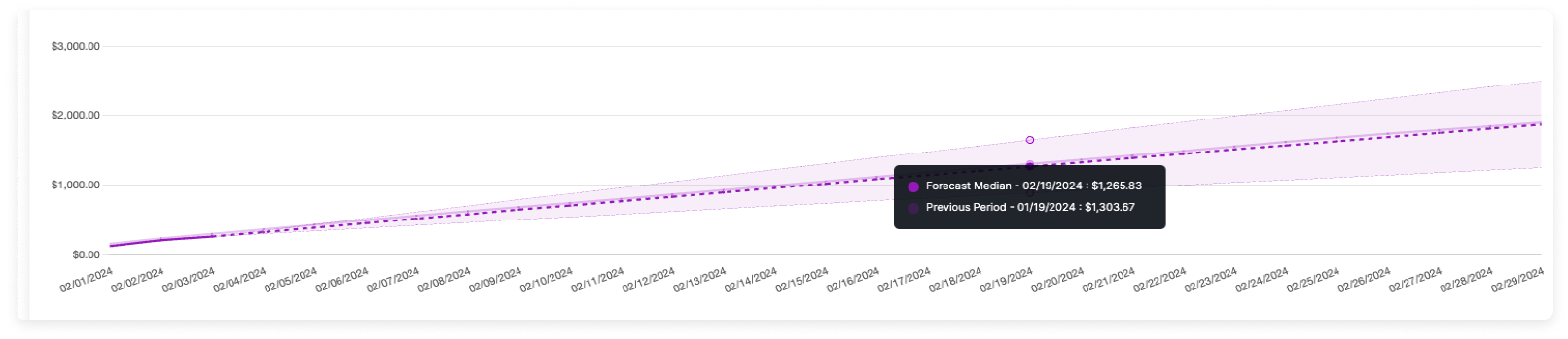
In the below example image, bars for future months are light purple. Error bars are present for future months to represent the upper and lower bounds of the forecast. When a date bin (day, week, or month) spans both past and future dates, the bar is partially purple to indicate the portion that is forecasted. For example, in this report binned weekly, the bar for January 19, 2026 is partially purple because that week includes both past and future dates; only the future portion of that week’s bar appears in purple. You can hover over any future date to see the forecasted min, max, and median. Total forecasted costs are displayed above the chart, next to currently accrued costs. Forecasts are also present in grouped bar charts.
View Service Forecasts
In addition to aggregate forecasts on Cost Reports, you can also view a per-service cost forecast. On any Cost Report, select a row from the table. An individual forecast is displayed for the selected service.Dynamic Forecast
Dynamic forecasting is available to Enterprise customers only.
How Dynamic Forecasting Works
Dynamic forecasting uses machine learning to learn how your business metrics correlate with costs by analyzing historical data. Vantage combines historical business metrics with your projected business metrics into a continuous time series. It then analyzes historical cost data alongside historical business metric values to learn correlation patterns and how changes in your metrics relate to changes in costs. Your forecasted business metric values are then incorporated into the forecasting model, which generates future cost predictions by applying the learned correlations to your projected metrics while accounting for baseline cost trends, seasonal patterns, and service-specific scaling factors. This process runs separately for each cloud service (EC2, RDS, S3, etc.) to account for how different services respond differently to business metric changes, and forecasts are constrained to date ranges where both historical and forecasted metrics exist, with label filters applied when specified. Example use cases are noted below.- Product Launch
- Seasonal Growth
- Testing Cycles
A SaaS company is launching a new feature and expects a 200% increase in API requests over the next three months. They have a business metric tracking API requests per day. By uploading projected API request values for the launch period, their cost forecast automatically adjusts to reflect the anticipated increase in compute and data transfer costs associated with the traffic spike.
Create a Dynamic Forecast
1
Set up your business metric and forecasted data
Follow the steps in the Forecasted Metrics section of the Business Metrics page to create a business metric, upload historical data, upload forecasted metrics, and assign it to a Cost Report.
2
View your dynamic forecast
Navigate to the associated Cost Report and click the Forecasts tab. The Forecasts tab displays a side-by-side comparison table showing forecasted costs by month for each forecast type: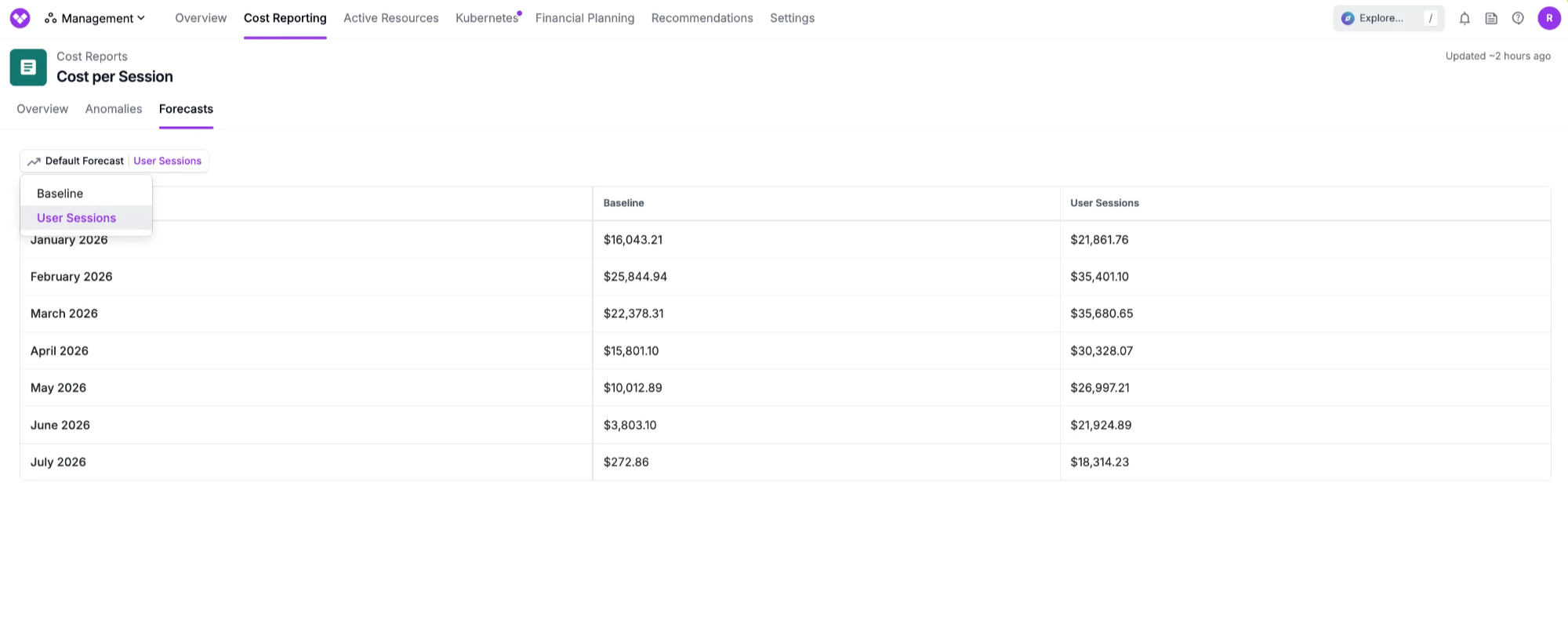
- Baseline: The default time-series forecast based on historical trends
- Dynamic (based on a business metric): Forecasts that incorporate projected business metric values (one for each business metric assigned to the report)
On this tab, if no forecasts are available yet, you’ll see a “Generating Forecast” message asking you to check back once they’re done. If only business metric forecasts are still generating, a blue alert banner will indicate which forecast is being generated (e.g., “Generating User Sessions Forecast: Check back once cost data has been processed”). In the forecast table, zero values or periods with no forecast are displayed as a ”-” (dash).
Label Filters and Dynamic Forecasts
If you have applied a label filter for a business metric on a Cost Report, Vantage will use the same label filter when applying projected business metrics to your forecast, as long as your forecasted metrics include the same label structure as your historical data. See the Labeled Business Metrics section for more information about using labels.Update Dynamic Forecasts
Any time you update your forecasted business metrics, Vantage automatically recalculates all associated forecasts. All Cost Reports using that business metric will reflect the updated projections within approximately 10 minutes. You don’t need to manually refresh or regenerate forecasts.Scenario Model Forecasts
Scenario Model forecasting is available to Enterprise customers only.
How Scenario Models Combine
A Scenario Model forecast starts from a base forecast and then adjusts it with your Scenario Model amounts, month by month. The base is the Baseline Forecast by default, or the Dynamic Forecast if you also pick a business metric on the same forecast (see Combine Scenario Models with a business metric). Each Scenario Model adjusts the forecast in one of two ways:- Dollar Amount models add or subtract a fixed amount. Each month, the model’s amount is added to the forecast, moving the whole forecast (its middle estimate and its high and low range) up or down by that amount. The range stays the same size. Dollar amounts apply to the report’s total forecast; if a model is filtered to a specific provider and service, the amount is only applied when that provider or service appears in the report.
- Percentage models raise or lower the forecast by a percentage (for example,
+10%or-5%). Because the change is a percentage, the high and low range grows or shrinks along with the forecast. If a model is filtered to a specific provider and service, the percentage only applies to that provider or service’s share of the forecast, and the change is reflected in the report total.
$0 instead of showing a negative number.
Each percentage Scenario Model needs a unique Priority, which sets the order they’re applied in. Dollar models are applied after percentage models, and their amounts simply add together.
Example (Dollar Models)
Suppose the Baseline Forecast on a Cost Report predicts the following for July 2026:- Median:
$42,000 - Range:
$38,000to$46,000
- H2 Committed Use Discount:
$15,000per month from July through December 2026 (additional committed spend). - AWS MAP Credit:
-$8,000per month from June through September 2026 (a credit, entered as a negative amount).
$15,000 + (−$8,000) = $7,000. Vantage adds that overlay to every point in the Baseline Forecast for July:
The same math runs for every forecasted month, so months where no Scenario Model period applies are left at the Baseline Forecast value.
Example (Multiple Models by Priority)
Selecting several Scenario Models on one forecast shows how percentage and dollar models combine. Suppose the base forecast for a month has a median of$100,000, and you attach three models:
- Q3 Efficiency Program:
-5%(Percentage), priority1. - New Region Uplift:
+10%(Percentage), priority2. - H2 Committed Use Discount:
+$15,000(Dollar Amount).
The same sequence is applied to the upper and lower ends of the forecast range, and the final values never drop below
$0. Each percentage model must have a unique Priority so Vantage applies them in a consistent order.
Combine Scenario Models with a Business Metric
When you also select a business metric on the forecast, the base becomes the Dynamic Forecast for that business metric instead of the Baseline Forecast. The Scenario Model amounts are then applied on top of the Dynamic base using the same rules above (percentages first by priority, then dollar amounts, and the result never drops below$0). If the selected business metric does not have both historical and forecasted values, the forecast cannot be generated.
Important Details
Keep the following in mind when you build forecasts from Scenario Models:- Credits and discounts: Enter credits, refunds, and planned savings as negative amounts on a Scenario Model period.
- Granularity: Scenario Model periods are always defined in whole months, and the Forecasts tab comparison view displays monthly values.
- Periods outside the forecast window: Periods (or portions of periods) that fall entirely before the forecast start date or after the forecast end date are ignored. Partial overlap is clipped to the window.
Create a Forecast from Scenario Models
Follow these steps to build a new forecast on a Cost Report from one or more Scenario Models:1
Create your Scenario Models
To build a forecast from Scenario Models, create at least one Scenario Model first. Navigate to Financial Planning > Scenario Models and follow the steps in the Scenario Models documentation to create the models that represent your known future costs, credits, or trends. (A forecast can also be created from a business metric alone, without any Scenario Models, as described below.)
2
Navigate to Forecasts
On any Cost Report, click the Forecasts tab.
3
Create a new forecast
Click the Default Forecast dropdown and select Create new forecast. The Create New Forecast panel opens.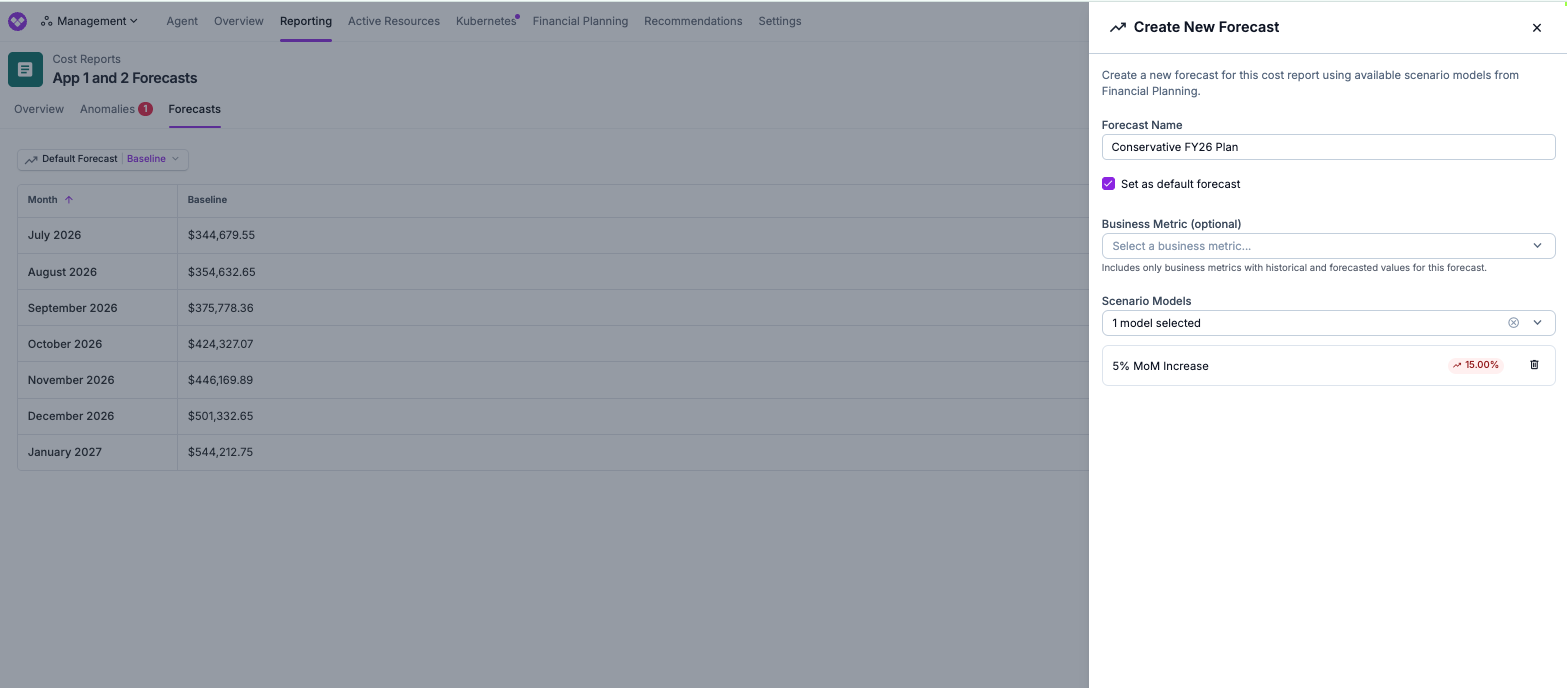
4
Name the forecast and choose its inputs
Enter a Forecast Name (for example, Conservative FY26 Plan or H2 with MAP Credits). Under Scenario Models, select one or more of your existing models to apply to this forecast.You can optionally also choose a Business Metric to base the forecast on a Dynamic Forecast (only business metrics that have both historical and forecasted values for this report are listed). A forecast must include at least one Scenario Model or a business metric.Each selected Scenario Model appears in a summary list showing its Net Change badge and an (Expired) label if all of its periods have ended. Click the remove (x) button on a row to drop a model before saving.
5
Optionally set as default
Check Set as default forecast if you want this forecast to appear as the primary forecast on the Cost Report’s Overview tab.
6
Save
Click Save Forecast. Vantage will begin generating the forecast. While generation is in progress, the Forecasts tab displays a Generating Forecast status. Most forecasts complete within approximately 10 minutes. Once generation completes, the new forecast appears in the Forecasts table alongside the Baseline Forecast.
Model Multiple Scenarios
You can create multiple Scenario Model forecasts on the same Cost Report to model different scenarios side by side. For example, you might build one forecast that reflects only committed discounts and a second forecast that also includes credits expected from a provider-negotiated program. Each forecast is independent and can be applied to the Cost Report individually via the Default Forecast dropdown.Edit or Delete a Scenario Model Forecast
From the Forecasts tab, click the edit icon next to a forecast to update its name or change which Scenario Models are applied. If you change the applied Scenario Models, Vantage automatically reprocesses the forecast; updates typically appear within approximately 10 minutes. To delete a forecast, use the delete action on the same column. If the deleted forecast was the Cost Report’s default forecast, the Cost Report reverts to the Baseline Forecast as the default.The Baseline Forecast is always available and cannot be deleted from the Forecasts tab. A Dynamic forecast is created automatically when you assign a business metric to the Cost Report, and removed when you unassign it. You can also create a forecast from a business metric directly in the Create New Forecast panel (with or without Scenario Models); forecasts created this way can be edited or deleted from the Forecasts tab.
Update Scenario Models Attached to a Forecast
Any time you edit a Scenario Model from its detail page (for example, editing a period or amount), Vantage automatically reprocesses every forecast that references that model, and affected Cost Reports reflect the updated values within approximately 10 minutes. Changes made through a CSV import are applied to the models immediately, and forecasts that reference them are refreshed on the next scheduled forecast run. You don’t need to regenerate forecasts manually.Compare Forecast Types
The Forecasts tab displays a monthly, side-by-side comparison of every forecast available on the Cost Report:- Baseline: The default time-series forecast based purely on historical trends.
- Dynamic (per business metric): One column per business metric assigned to the report, if any.
- Scenario Model forecasts: One column per forecast you have built from Scenario Models on the report, labeled with the name you gave it.
- (dash).
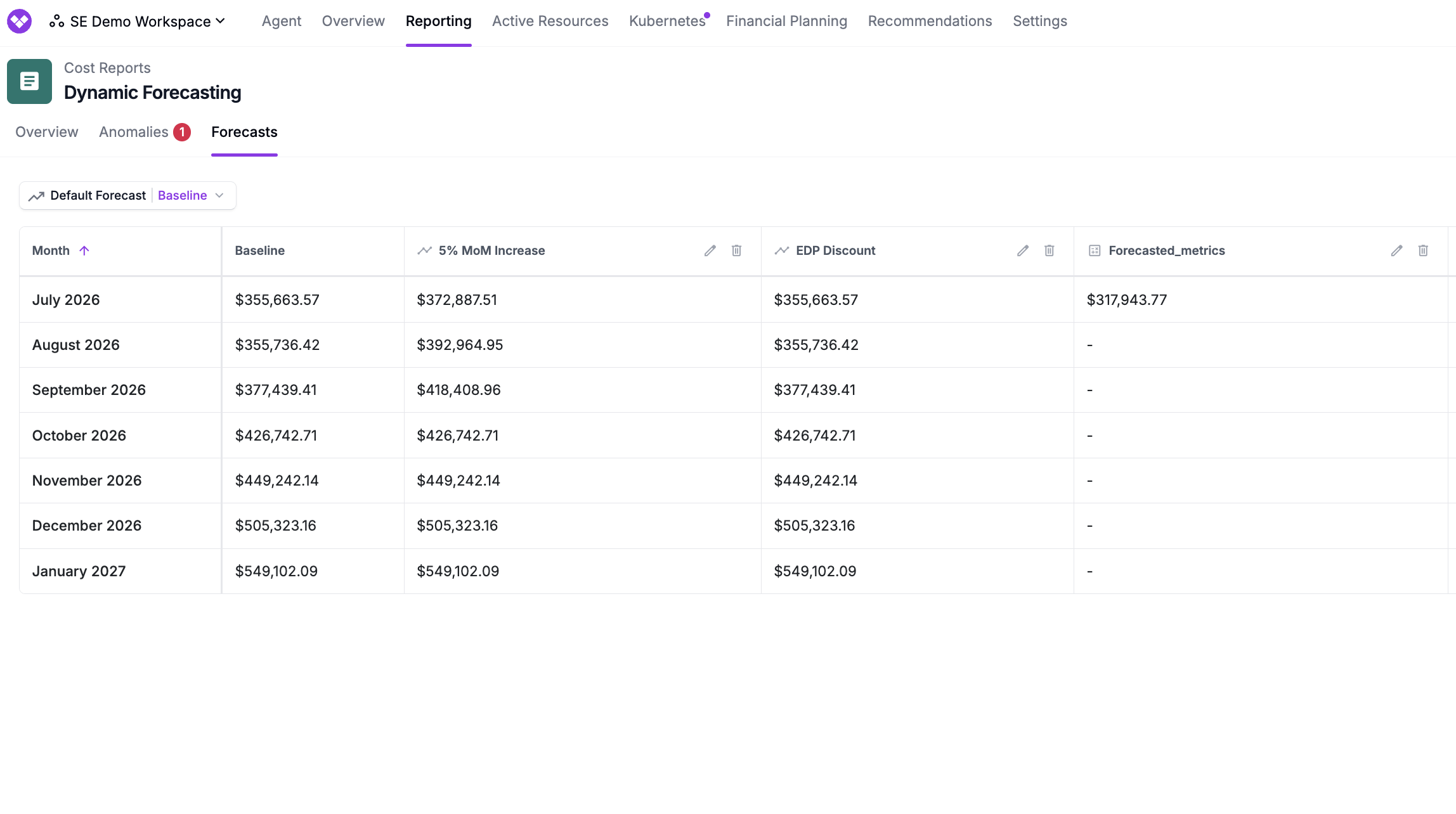
Each column header includes a small icon that indicates the forecast type: the Baseline column has no icon, Scenario Model forecasts use a timeline icon, and Dynamic (business metric) forecasts use a calculator icon. In the example below, the Forecasts tab compares four forecasts on one Cost Report: the Baseline, two Scenario Model forecasts (5% MOM increase and EDP Discount), and one Dynamic forecast driven by a business metric (Forecasted_metrics).