> ## Documentation Index
> Fetch the complete documentation index at: https://docs.vantage.sh/llms.txt
> Use this file to discover all available pages before exploring further.
# Linear MCP
> Connect the Linear MCP to the Vantage FinOps Agent to bring your issues, projects, and teams into the same conversation as your Vantage cost data.
The Linear MCP Connector links the [Vantage FinOps Agent](/vantage_finops_agent) to your [Linear](https://linear.app) workspace. Once connected, the Agent can search your issues, projects, and teams and create or update issues on your behalf, so a cost finding can turn into tracked engineering work without leaving Vantage.
The Linear MCP Connector is one of several [MCP Connectors](/vantage_finops_agent#mcp-connectors) for the FinOps Agent. It is available to all Vantage customers using the FinOps Agent, in the [Vantage console](https://console.vantage.sh/agent), Slack, and [Canvas](/canvas).
## Prerequisites
Before you start, make sure you have:
* The [FinOps Agent](/vantage_finops_agent) enabled in Vantage. The Linear MCP settings page prompts you to enable it first if it is not already on.
* A Vantage role that can manage integrations, such as **Organization Owner** or **Integration Owner**, to enable the connector for your organization. See [Role-Based Access Control](/rbac) for details.
* A Linear account. Each Vantage user who wants to use the connector authorizes their own Linear account, so there is no required Linear role.
## How the Connection Works
The Linear MCP uses a two-part connection model, and the order matters:
1. **Start here (Organization Owner or Integration Owner):** enable the Linear MCP for your organization once, from the **Organization Settings** tab on the [Integrations page](https://console.vantage.sh/settings/integrations). Until this is done, other users see a prompt to contact an Owner or Integration Owner.
2. **Then, each user:** authorize your own Linear account from the **MCP Settings** tab, or when the Agent prompts you mid-conversation.
Per-user authorization is required because Linear content is scoped to the requesting user (your assigned issues, the teams and projects you can see). The Agent acts with your own Linear permissions and can only take actions you could take directly in Linear.
### Settings Tabs
The Linear MCP settings page has up to two tabs:
* **MCP Settings**: connect, disconnect, or reconnect your own Linear account and view your personal connection status. Every user has this tab.
* **Organization Settings** (Organization Owners and Integration Owners only): enable or disable the Linear MCP for the whole organization and view the list of users who have connected.
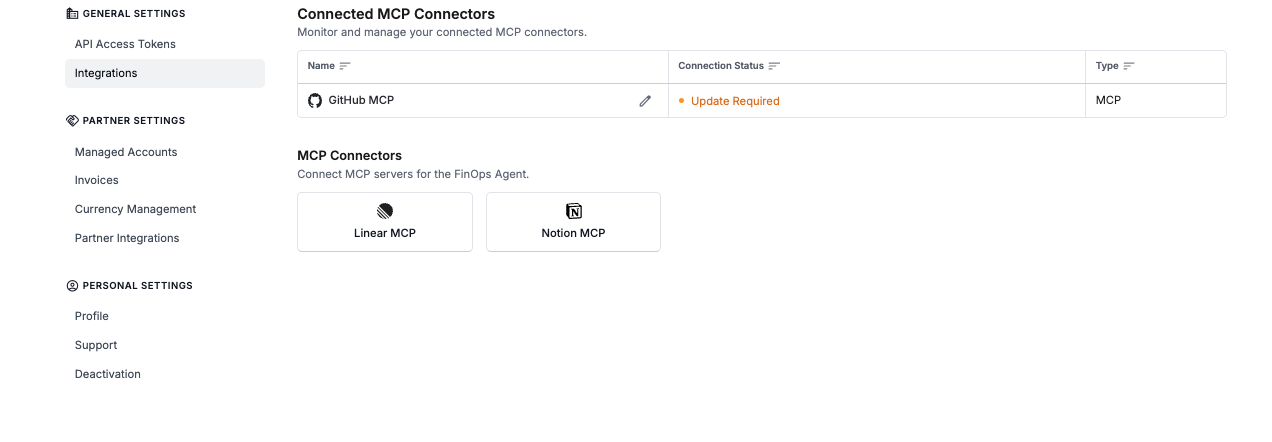
Once the Linear MCP is enabled for your organization, any Vantage role (down to Organization Viewer) can connect their own Linear account. Enabling it also lets **Organization Editors and Organization Viewers** open Settings > Integrations, where they see only the **MCP Connectors** section. A connector you have not connected yet shows as **Not Connected**. See [Role-Based Access Control](/rbac) for details.
 ## Permissions and Data Access
When you authorize Linear, Vantage requests OAuth scopes that let the Agent read and write on your behalf:
| Scope | Why Vantage needs it |
| ------- | ------------------------------------------------------------------------------- |
| `read` | Search and view issues, projects, teams, and comments in your Linear workspace. |
| `write` | Create and update issues and add comments on your behalf. |
Once connected, the FinOps Agent can:
* Search and view issues, projects, and teams.
* Create and update issues on your behalf.
* Add comments and collaborate in your Linear workspace.
Write actions are always bounded by your own Linear permissions. Because you authorize your own account, the Agent can only create or change what you could change directly in Linear.
Vantage stores only the data that is explicitly written into your FinOps Agent conversation responses or a [Canvas](/canvas) report; no ancillary Linear data is collected or stored outside of your conversation, and data retrieved through the connector is not used to train any models.
Vantage does not support authenticating to the Linear MCP with a Linear API key or a pre-generated OAuth token. Each user must connect through the standard interactive OAuth flow described below.
## Available Tools
The FinOps Agent connects to Linear's hosted MCP server and chooses the right tools automatically based on your question. Available functionality includes:
* **Find and read**: search and view issues, projects, teams, cycles, and comments.
* **Create and update**: create and update issues and add comments on your behalf.
The Agent only creates or modifies Linear content when you explicitly ask it to. For a write, it first confirms the target (the team and owner) and searches for an existing issue before creating a new one, and all writes are bounded by your own Linear permissions. In [Canvas](/canvas), the Linear MCP is read-only, so write actions are not available there. If a write returns an authorization or scope error, the Agent surfaces it and points you back to the **Linear MCP** settings page to reconnect rather than retrying.
## Connect the Linear MCP
As an **Organization Owner** or **Integration Owner**, click **Settings** in the top navigation. On the left navigation, select **Integrations**, then find the **MCP Connectors** section and select **Linear MCP**. In the **Organization Settings** tab, enable the connector for your organization.
If the page shows a banner asking you to enable the FinOps Agent, open the [FinOps Agent settings page](https://console.vantage.sh/settings/finops_agent) and enable it first, then return to the Linear MCP page.
On the **Linear MCP** page, open the **MCP Settings** tab and click **Connect Linear**. Vantage redirects you to Linear to complete the OAuth flow. Every user who wants to use the connector completes this step for their own account.
Sign in to Linear and authorize the requested access. After you approve, Linear redirects you back to Vantage and your connection status changes to connected.
Back in Vantage, confirm the Linear MCP shows as connected. You can now ask the FinOps Agent Linear-aware questions in the console or in Slack.
You can also connect Linear directly from an Agent conversation. When you ask the Agent to do something that needs Linear and you have not connected yet, it prompts you to authorize your account inline.
## Example Use Cases
Once the Linear MCP is connected, the FinOps Agent decides when to reach for Linear tools based on the question you ask. It can call Linear tools in the same turn it uses Vantage tools, combining cost data with your issue tracking.
For prompting best practices and more copy-paste examples, see the [FinOps AI Prompt Guide](/finops_ai_prompt_guide).
### Triage a Cost Anomaly Against Existing Work
When Vantage surfaces a cost spike, ask the Agent to search Linear for existing issues related to the affected service or team before you open a new one.
We have an anomaly on our EKS costs this week. Is there already a Linear issue tracking work on that cluster?
### Create an Issue From a Recommendation
Ask the Agent to create a Linear issue for a rightsizing recommendation, cost anomaly, or budget overrun, pre-populated with the underlying cost context. Name the target team so the Agent can create the issue without stopping to confirm where it belongs.
Create a Linear issue on the Product team for my top cost optimization recommendation this month, including the resource, current and recommended configuration, and estimated monthly savings.
### Route an Optimization to the Right Team
Ask which Linear team owns a given service or cost center so an optimization task lands with the right owner.
Which Linear team owns our data platform services? Create an issue there to investigate the Redshift cost increase.
### Track an Optimization Initiative
Reference a Linear project for an optimization initiative and ask the Agent to correlate its progress with cost trends in Vantage.
Look at our "Cloud Cost Reduction" Linear project and tell me whether the closed issues line up with the drop in our AWS spend this quarter.
## Troubleshooting
Enable the [FinOps Agent](/vantage_finops_agent) first from the [FinOps Agent settings page](https://console.vantage.sh/settings/finops_agent), then return to **Settings** > **Integrations** > **MCP Connectors** > **Linear MCP**.
An **Organization Owner** or **Integration Owner** must enable the Linear MCP for your organization before individual users can authorize their accounts. If you do not see the option to connect, ask an administrator to enable it from the [Integrations page](https://console.vantage.sh/settings/integrations).
Confirm the Linear MCP shows as connected for your user and that your question requires Linear context. The Agent prefers Vantage tools for pure cost questions and reaches for Linear when you ask about issues, projects, teams, or want to create or update an issue.
Your Linear OAuth grant may have been revoked or expired. Reconnect Linear from the **Linear MCP** page to re-authorize your account.
If you disconnect your own account, the Linear tools are no longer available to the FinOps Agent for you. If an administrator disables the connector for the organization, every user's Linear connection is disconnected. Previous conversations retain their historical responses based on your data retention period, but the Agent can no longer call Linear after it is disconnected.
## Permissions and Data Access
When you authorize Linear, Vantage requests OAuth scopes that let the Agent read and write on your behalf:
| Scope | Why Vantage needs it |
| ------- | ------------------------------------------------------------------------------- |
| `read` | Search and view issues, projects, teams, and comments in your Linear workspace. |
| `write` | Create and update issues and add comments on your behalf. |
Once connected, the FinOps Agent can:
* Search and view issues, projects, and teams.
* Create and update issues on your behalf.
* Add comments and collaborate in your Linear workspace.
Write actions are always bounded by your own Linear permissions. Because you authorize your own account, the Agent can only create or change what you could change directly in Linear.
Vantage stores only the data that is explicitly written into your FinOps Agent conversation responses or a [Canvas](/canvas) report; no ancillary Linear data is collected or stored outside of your conversation, and data retrieved through the connector is not used to train any models.
Vantage does not support authenticating to the Linear MCP with a Linear API key or a pre-generated OAuth token. Each user must connect through the standard interactive OAuth flow described below.
## Available Tools
The FinOps Agent connects to Linear's hosted MCP server and chooses the right tools automatically based on your question. Available functionality includes:
* **Find and read**: search and view issues, projects, teams, cycles, and comments.
* **Create and update**: create and update issues and add comments on your behalf.
The Agent only creates or modifies Linear content when you explicitly ask it to. For a write, it first confirms the target (the team and owner) and searches for an existing issue before creating a new one, and all writes are bounded by your own Linear permissions. In [Canvas](/canvas), the Linear MCP is read-only, so write actions are not available there. If a write returns an authorization or scope error, the Agent surfaces it and points you back to the **Linear MCP** settings page to reconnect rather than retrying.
## Connect the Linear MCP
As an **Organization Owner** or **Integration Owner**, click **Settings** in the top navigation. On the left navigation, select **Integrations**, then find the **MCP Connectors** section and select **Linear MCP**. In the **Organization Settings** tab, enable the connector for your organization.
If the page shows a banner asking you to enable the FinOps Agent, open the [FinOps Agent settings page](https://console.vantage.sh/settings/finops_agent) and enable it first, then return to the Linear MCP page.
On the **Linear MCP** page, open the **MCP Settings** tab and click **Connect Linear**. Vantage redirects you to Linear to complete the OAuth flow. Every user who wants to use the connector completes this step for their own account.
Sign in to Linear and authorize the requested access. After you approve, Linear redirects you back to Vantage and your connection status changes to connected.
Back in Vantage, confirm the Linear MCP shows as connected. You can now ask the FinOps Agent Linear-aware questions in the console or in Slack.
You can also connect Linear directly from an Agent conversation. When you ask the Agent to do something that needs Linear and you have not connected yet, it prompts you to authorize your account inline.
## Example Use Cases
Once the Linear MCP is connected, the FinOps Agent decides when to reach for Linear tools based on the question you ask. It can call Linear tools in the same turn it uses Vantage tools, combining cost data with your issue tracking.
For prompting best practices and more copy-paste examples, see the [FinOps AI Prompt Guide](/finops_ai_prompt_guide).
### Triage a Cost Anomaly Against Existing Work
When Vantage surfaces a cost spike, ask the Agent to search Linear for existing issues related to the affected service or team before you open a new one.
We have an anomaly on our EKS costs this week. Is there already a Linear issue tracking work on that cluster?
### Create an Issue From a Recommendation
Ask the Agent to create a Linear issue for a rightsizing recommendation, cost anomaly, or budget overrun, pre-populated with the underlying cost context. Name the target team so the Agent can create the issue without stopping to confirm where it belongs.
Create a Linear issue on the Product team for my top cost optimization recommendation this month, including the resource, current and recommended configuration, and estimated monthly savings.
### Route an Optimization to the Right Team
Ask which Linear team owns a given service or cost center so an optimization task lands with the right owner.
Which Linear team owns our data platform services? Create an issue there to investigate the Redshift cost increase.
### Track an Optimization Initiative
Reference a Linear project for an optimization initiative and ask the Agent to correlate its progress with cost trends in Vantage.
Look at our "Cloud Cost Reduction" Linear project and tell me whether the closed issues line up with the drop in our AWS spend this quarter.
## Troubleshooting
Enable the [FinOps Agent](/vantage_finops_agent) first from the [FinOps Agent settings page](https://console.vantage.sh/settings/finops_agent), then return to **Settings** > **Integrations** > **MCP Connectors** > **Linear MCP**.
An **Organization Owner** or **Integration Owner** must enable the Linear MCP for your organization before individual users can authorize their accounts. If you do not see the option to connect, ask an administrator to enable it from the [Integrations page](https://console.vantage.sh/settings/integrations).
Confirm the Linear MCP shows as connected for your user and that your question requires Linear context. The Agent prefers Vantage tools for pure cost questions and reaches for Linear when you ask about issues, projects, teams, or want to create or update an issue.
Your Linear OAuth grant may have been revoked or expired. Reconnect Linear from the **Linear MCP** page to re-authorize your account.
If you disconnect your own account, the Linear tools are no longer available to the FinOps Agent for you. If an administrator disables the connector for the organization, every user's Linear connection is disconnected. Previous conversations retain their historical responses based on your data retention period, but the Agent can no longer call Linear after it is disconnected.